

The key theme for procurement trends in 2026 seems to be uncertainty. Interest rates, tariffs, rising prices, shifting customer demand, shifting market dynamics, geopolitical conflicts, supply chain disruptions: the list is long and growing.
Things can change in an instant, and you need to have credit intelligence integrated into your system to make better decisions about supplier risk management. You can no longer rely on manual reviews and annual assessments that focus mainly on a supplier’s historical performance. It takes real-time visibility into your suppliers’ financial stability to avoid disruptions that impact your bottom line.
Traditional supplier evaluations overlook the earliest signals of potential disruption.
Everything might look fine. A supplier has a strong, consistent history of delivery and favorable metrics, but behind-the-scenes, they experience tight cash flow, getting close to their credit limits with their suppliers, and slowing down their payments to creditors. If you can see these warning signs before they affect deliveries, you can adjust your procurement forecast and take action. For many companies, this can be the difference between profitability and significant problems.
When you build strong financial visibility into your procurement, you’re better positioned to see key purchase insights and avoid suppliers’ financial trouble from affecting your customers. These procurement strategy insights can help you avoid supply chain disruptions, diversify suppliers strategically, and build resiliency.
Supplier Risk Management Has Reached a Turning Point
Even if things seem to be running smoothly now, you should know that many of your peers are showing concerns. "Today's supply chain landscape is more volatile than ever," said John D'Aleo, CEO at RapidRatings. "Risks are evolving at an unprecedented pace.” In a survey asking about the future of procurement, 62% of supply chain leaders and procurement professionals rated the global supply chain risks as high or very high. More than two-thirds said the future of procurement includes risk rising even further.
Increased Financial Volatility Across Supplier Networks
In recent years, many suppliers have struggled to maintain a stable financial footing. Rising borrowing costs, inflation, raw material scarcity, and unpredictable customer demand have created cash flow pressures that can ripple through production, labor availability, and delivery schedules. Your procurement forecast can look fine until suddenly your suppliers can no longer deliver on their promises.
Consider this: When U.S. companies close their books on 2025, insolvencies are expected to hit 6% and forecast to reach 7% in 2026.
Greater Interdependency and Fragility in Global Networks
Supply chains are more complex than ever, globally interconnected, and rarely single-source. Even if your Tier 1 partner is financially healthy, an upstream Tier 2 or Tier 3 supplier that’s having cash flow problems can halt production for your supplier. This interdependency means you need to see the warning signs faster.
Credit intelligence is key to risk mitigation. Procurement trends in 2026 include taking a deeper dive into your supply chain.
Stronger Executive Expectations for Forecasting
In a 2025 survey, 94% of companies report that their revenue was negatively affected by supply chain disruptions. When disruptions show up unexpectedly, the costs can be significant. One estimate puts total business losses at $182 million annually.
To operate efficiently, you need greater procurement forecast accuracy. Executives expect your team to know how suppliers are performing today and how stable and reliable they are likely to be in the next quarter and year.
What Are the Top Procurement Trends for 2026?
One of the biggest procurement trends is the adoption of AI in sourcing and buying. Gartner forecasts that 70% of large enterprises will have an AI-driven procurement process in place by 2030. Another survey goes further, predicting that 86% of organizations will implement or scale their AI efforts in procurement by 2026.
Whichever statistics you want to believe, it’s clear that the trends in procurement include adopting technology and data that shift from reactive decision-making towards predictive risk management as a core strategy. Credit intelligence about your suppliers is critical to identify the key purchase insights you need to reduce your risk. Against this backdrop, here are some top trends and how experts see the future of procurement shaping up.
Predictive Supplier Risk Detection Becomes Standard
Rather than limiting supplier risk assessments to onboarding or annual reviews, credit data is being embedded into the entire procurement process, starting at sourcing. Supplier scoring includes monitoring financial indicators such as:
- Business credit score changes
- Increasing Days Beyond Terms (DBT) payments
- Rising credit utilization
- New liabilities, liens, or lawsuits
When you include these signals in your supplier scoring models, you can see risks more clearly and get advanced warning of potential trouble.
Real-Time Monitoring Replaces Static Annual Reviews
Financial stability can shift rapidly, especially in industries vulnerable to seasonal cycles, commodity fluctuations, capital pressure, or dependent on supply chains that include regions prone to geopolitical turmoil.
Continuous monitoring gives you the procurement strategy insights you need to monitor supplier conditions and take action when necessary.
More Strategic Category Planning Built onFinancial Resilience
Category strategies are evolving. Rather than settling on a particular supplier based on cost, capability, and historical performance, procurement teams are also looking at long-term resilience and financial capacity to scale. You need to know whether suppliers are able to grow with you and meet increased demand when needed.
How Can Procurement Become More Strategic?
Procurement teams have traditionally evaluated suppliers through operational metrics such as on-time delivery, quality scores, and production capacity. However, suppliers may have underlying financial issues that don’t show up in these measurements.
Yet, financial insights were typically the domain of finance departments and not integrated into the procurement process. That’s changing, and for good reason. Your supplier might have a stellar record of on-time delivery but have a serious cash flow problem that’s preventing them from buying the materials they need to fill your next order. In the past, warning signs were often discovered after-the-fact, when a supplier missed shipment deadlines or was unable to meet your demand. Because procurement teams lacked access to credit trends, payment behavior data, and real-time financial indicators, they would miss the red flags that would spur them to take action.
Procurement industry trends are centering on moving beyond the traditional approach and embedding credit intelligence directly into the procurement process. Here’s how the two strategies compare.
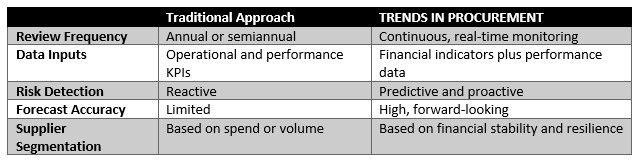
The insights gained help you strengthen supplier selection, negotiate better terms, and avoid awarding business to suppliers that may not be able to support your long-term requirements. With this data, you can also put several key strategies in place:
- Identify high-value, low-risk suppliers: Find financially strong suppliers that are capable of absorbing economic downturns or market shocks.
- Reduce reliance on high-risk suppliers: Uncover the most at-risk suppliers within your portfolio so you can find secondary sources and diversify effectively.
- Strengthen negotiations with data: Knowing the financial health of suppliers can help you negotiate better pricing structures and performance guarantees.
The Benefits of Integrating Credit Intelligence into Procurement
Procurement teams today are often tasked with doing more with less: fewer resources, smaller teams, and budgets that don’t always reflect today’s pricing structure. Credit intelligence is a powerful ally in helping you fulfill your mission. Key benefits include:
- Faster decision cycles: Even in complex supply chains, the right data can help you react more quickly to avoid surprise disruptions.
- Scaling procurement: Financial visibility can help you automate workflows from sourcing to renewals.
- Stronger compliance: You get the insights you need to comply with risk tolerance requirements and provide evidence of your due diligence.
The Financial Signals Procurement Teams Rely On
Procurement teams use a consistent set of financial indicators to identify early warning signs and prioritize supplier risk mitigation. Here are some of the key procurement trends to monitor.
Credit Score Changes and Volatility
Changes or rapid fluctuations in credit scores often indicate growing financial instability. Monitoring these changes gives you time to intervene and plan properly.
Payment Behavior Trends
When you see payments to other suppliers start to slow down or go delinquent, there’s typically a cash flow problem. This can show up well before production capacity is reduced or orders start to have longer lead time.
Liabilities, Filings, and Public Records
Increases in liabilities, UCC filings, liens, or lawsuits are warning signs that there are financial challenges that might impact a supplier’s ability to deliver on their commitments.
Capital Investment and Growth Patterns
Suppliers who are laying off workers or cutting production capacity may be struggling with bigger issues. You need to know when this happens to adjust your procurement forecast and supplier strategy.
Benchmarking Suppliers Across Categories
You want to find the best long-term partners that meet your goals. Benchmarking financial performance against industry leaders provides insight into how suppliers fare vs. their peers.
How Credit Intelligence Supports Each Stage of the Supplier Lifecycle
Credit intelligence can be applied at each stage of the supplier lifecycle to provide the insights you need to make better decisions.
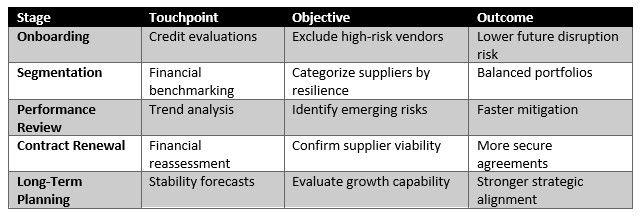
When you have financial visibility at every stage, you can act confidently.
Practical Takeaways for Procurement Teams
As industry analysts continue to forecast global volatility, increased regulatory scrutiny, and more pressure to deliver predictive insights, financial intelligence will be central to meeting these expectations. Credit intelligence will play an increasingly important role in forecasting supplier performance, preventing disruptions, and shaping long-term category plans.
The most important procurement trends in 2026 revolve around visibility, prediction, and resilience. Credit intelligence is becoming a core capability, giving you the ability to detect supplier instability before it affects your business.
To reduce risk for the future of procurement, you can strengthen your supplier risk management process by embedding financial visibility throughout your systems. Practical steps include:
- Build real-time financial monitoring into daily workflows.
- Incorporate financial indicators into category strategies.
- Train procurement teams on interpreting financial risk data.
- Use credit thresholds in sourcing events and supplier evaluations.
- Set up automated alerts for key indicators.
- Include financial reviews in supplier meetings.
FAQs—Frequently Asked Questions About Credit Intelligence and Procurement Trends
How do you assess supplier financial health? Review credit scores, payment behavior, debt levels, and public filings to understand stability and liquidity. These indicators help determine whether a supplier can reliably meet current and future obligations.
What is supplier credit risk? Supplier credit risk is the likelihood that a supplier’s financial situation will affect its ability to deliver goods or services. High credit risk increases the chance of delays, disruptions, or supplier failure.
How can you predict supplier failure? You can predict supplier failure better when you monitor financial signals like credit score drops, late payments, and rising liabilities that often appear months before operational performance declines.
What are the early warning signs of supplier financial distress? Early warning signs include slowing payments, declining credit scores, new liens or filings, and lengthening lead times. These signals typically emerge before major performance issues become visible.
Improve your risk management and gain greater insight into supplier stability with Command Credit. Schedule a free consultation with one of our credit intelligence experts to see how we can help enhance your procurement process.